Letting Coding Agents Build Strategy Systems for Balatro
What is Balatro?
Balatro is a roguelike deck-building game centered on scoring poker hands. A player begins each Run with a standard deck, scores points by playing hands, strengthens the build through the shop, and wins by defeating the Boss Blind in Ante 8. Draws, shops, and rewards change from Run to Run; losing starts a new Run.
Each Run repeatedly follows the same loop:
choose a Blind → play or discard → reach the target score → earn money → build in the shop → next Blind
- Blinds: A Run has eight Antes, each containing a Small Blind, Big Blind, and Boss Blind. The Small and Big Blinds can be skipped in exchange for a Tag, while the Boss Blind adds a rule that changes how the round plays.
- Playing a hand: The player selects one to five cards. Poker hands such as
pairs, two pair, straights, and flushes determine the base Chips and Mult.
Scoring cards and other effects modify both values, producing a final score
of
Chips × Mult. - Clearing a Blind: Scores from multiple hands accumulate within a Blind. Reaching the target Chips clears it; running out of hands ends the Run.
- Discarding: A discard replaces unwanted cards, using a limited resource to improve later hands.
- Building: Clearing a Blind awards money and opens the shop. Jokers change scoring, Planets level up poker hands, Tarot and Spectral cards modify the deck, Vouchers and Boosters provide longer-term upgrades, and rerolls spend money to refresh the shop.
The core challenge is allocating resources between clearing the current Blind and growing the build over time: which hand to play, when to discard, which Jokers to buy and how to order them, how much cash to keep, whether to skip a Blind, and how to handle Boss rules. Together, these decisions form a complete Balatro strategy.
Bringing Balatro into EvoPolicyGym
In EvoPolicyGym v0.3.0, we integrated the unofficial Balatro engine Jackdaw as a vendored dependency and used it to implement a Balatro evaluation Environment.
At every step, the Policy receives a public observation that includes:
- the Ante, Blind, target score, and remaining hands and discards;
- the hand, Jokers, Consumables, public deck statistics, and current poker-hand levels;
- the current shop, Boosters, Vouchers, Tags, and cash;
- a strict enumeration of legal Actions for the current phase;
- rule descriptions for visible objects in the pinned engine version.
The Policy returns a semantic Action such as playing, discarding, buying, selling, rerolling, opening a pack, or reordering Jokers. The Environment does not repair an invalid Action; it records a Policy failure. State may persist within one Episode, while every new Episode starts with a fresh Policy instance.
The final Policy score is:
number of Blinds cleared + 1000 × whether the Run was completed
Each cleared Blind contributes one point, and completing the Run adds 1,000 points. This preserves completion as the final objective while giving Policies that have not yet won continuous Feedback through their average progress.
A brief overview of the EvoPolicyGym evaluation process
During an EvoPolicyGym Run, a Coding Agent starts from an initial Program, repeatedly submits strategies, evaluates them on training Episodes, and continues optimizing from scores and replays. After the Agent finishes, Validation selects the final Program, and Assessment measures it on held-out test Episodes. Every submitted Program, its Feedback and replays, and the optimization record are retained in the Run data.
Experiment
We compared the packaged baseline with the Programs handed off by optimization Runs from three Coding Agents: Luna, Terra, and Sol. All three Agents started from the same baseline and used the same training Episode pool and Environment interaction budget.
The baseline is a deterministic poker-hand strategy. It enumerates every one-to-five-card combination in the current hand and chooses according to standard poker-hand rank and card values. In the shop, it buys the first affordable Joker; when opening a pack, it selects the first Joker. It does not use discards, Consumables, or rerolls, nor does it manage Joker combinations or the economy.
Luna, Terra, and Sol each received the same training Episode pool and a total Episode budget of 1,024. After optimization, we froze the Program selected by each Agent and evaluated all four Programs on the same 128 held-out test Episodes:
| Experiment | Agent | Reasoning | Training Episode budget | Test Episodes |
|---|---|---|---|---|
| Packaged baseline | — | — | 0 | 128 |
| Luna | gpt-5.6-luna | xhigh | 1024 | 128 |
| Terra | gpt-5.6-terra | xhigh | 1024 | 128 |
| Sol | gpt-5.6-sol | xhigh | 1024 | 128 |
The experiment used Red Deck, White Stake, a Run seed of 20260729, and a
60-second timeout for each Episode.
Results

Sol was the only model to produce a strategy capable of completing a Run. It cleared 10.45 Blinds on average, 2.83 times the baseline result, and completed 5 of 128 Runs. Luna and Terra also more than doubled the baseline's average progress, but neither completed a Run. Reducing early mistakes can extend a Run; completing one requires a coherent long-term build strategy.
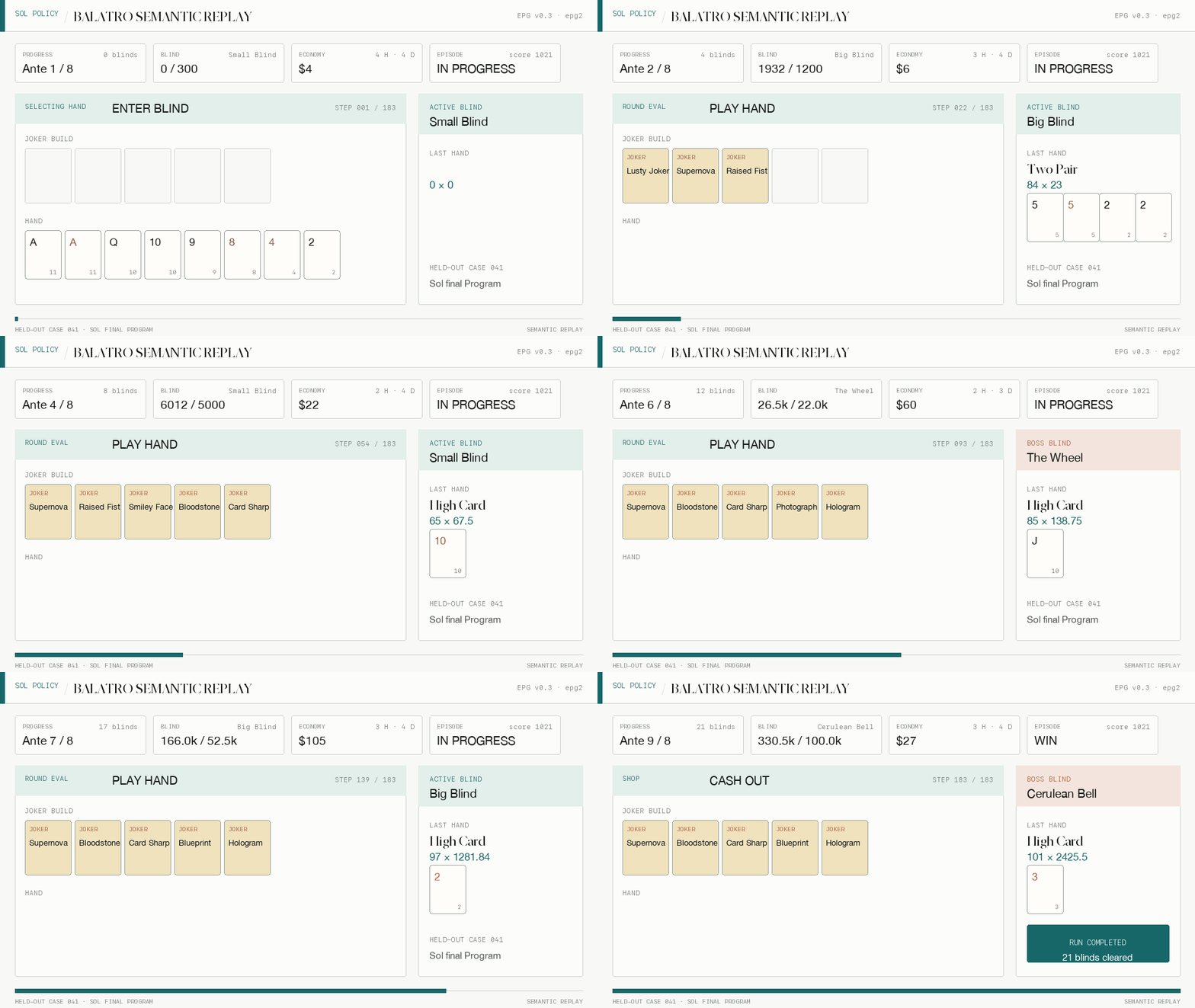
Held-out case index 41 from the same 128-Episode test set. The geometric rendering was generated from the Benchmark's semantic replay and contains no official Balatro game assets.
The baseline's capability boundary
The packaged baseline enumerates every one-to-five-card combination in the current hand, preferring combinations with a higher standard poker-hand rank and card values. In the shop and when opening packs, it selects the first Joker that meets its conditions.
It answers “which hand ranks higher right now,” but does not connect projected score, discards, Joker combinations, economy, and Boss rules.
What strategy did Sol build?
Sol built an approximate model of the game state and applied a coordinated set of heuristics for each phase. The final Policy changed in three main ways.
Score estimation and hand planning
Sol still enumerates one-to-five-card combinations, but evaluates their
expected Chips × Mult. The estimate accounts for poker-hand levels, scoring
cards, Enhancements, Editions, held-in-hand effects, and Joker combinations.
The Policy combines that estimate with the target score and the remaining hands and discards to decide whether to play immediately or keep searching. It protects cards with value while held in hand and, when no discards remain, can play low-value cards to draw replacements.
Joker construction and economy management
Sol estimates Joker value, seeks stable combinations of Chips, Mult, and X Mult, and reorders Jokers according to effect dependencies. When all slots are full, it replaces an existing component only if the candidate Joker is clearly stronger.
Shop decisions are also tied to the build. Based on the Ante, available cash, and missing components, the Policy decides whether to buy, preserve interest, or reroll. Cash is used to strengthen later rounds, not just the current shop.
Cross-round state management
The Policy records shop visits, pack openings, poker hands, and skipped Blinds, then adapts its behavior to Boss rules. Score estimates influence discards, discards affect the probability of clearing the Blind, and the resulting economy changes the next round's build, forming a complete decision loop.
How models use Environment Feedback
Given the same baseline, training data, and budget, Sol was the only model to complete a Run. It used replay and score Feedback more effectively, organizing local lessons into a complete strategy spanning hands, construction, and economy—more like an experienced player.
Sol's Policy also reveals an engineering problem: about 1,860 lines of logic are concentrated in a single file, creating tight coupling. The next step is to separate the strategy into modules that are easier to test, calibrate, and continue improving.
Next steps
The first direction is Skills. An effective Skill can provide more than domain knowledge: it can also provide methods for modularization, replay analysis, and testing. Comparing the same Agent and budget with and without a Skill would measure both the final score and the engineering structure of the Policy.
The second direction is cross-Environment RL. The goal is not to memorize one Environment's rules, but to learn how to locate failures, form hypotheses, design experiments, and update strategies—and transfer that process to an unseen Environment.
While integrating different Environments, we also encountered another valuable but underexplored question: can an Agent observe an external system and build an Environment suitable for training and evaluation? For example, can an Agent understand a game's core rules and implement a behaviorally equivalent engine that strips away strategy-irrelevant details such as art and audio, retaining only states, Actions, and Feedback?
Answering this requires measuring whether an Agent can correctly abstract states, Actions, Feedback, and evaluation rules. Today we primarily evaluate how Agents use Environments to optimize strategies; Environment construction itself still lacks systematic measurement. If an Agent can do this well, its Environment can be integrated into EvoPolicyGym and used for further strategy optimization. This complete loop—from observation to modeling to optimization—could help future Agents adapt to new Environments faster and build effective decision systems.
Code and notes
This Benchmark is unaffiliated with LocalThunk, Playstack, or the official Balatro project and contains no official card faces, artwork, music, fonts, or other game assets.