Perception or Planning? Policy Evolution in Crafter
Crafter is an open-world survival game where an agent must stay alive while exploring, gathering resources, fighting enemies, and progressing through a crafting technology tree. Unlike environments with a short and well-defined objective, success in Crafter requires many decisions to remain coordinated over hundreds of steps.
For a coding Agent evolving a Policy, this creates two intertwined challenges:
- Perception: recover nearby terrain, entities, inventory, and player status from the observation.
- Long-horizon control: turn that state into a coherent strategy for survival, exploration, combat, and development.
In this experiment, we separate these two sources of difficulty. We evaluate GPT-5.6 Sol, Terra, and Luna under the same Crafter task, but give their evolved Policies either the original RGB observation or a local symbolic representation of the same visible state.
The difference is substantial for Sol and Terra, but much smaller for Luna. Removing most visual recognition work therefore exposes different bottlenecks in the Policies evolved by the three coding Agents.
Crafter as a Policy-Evolution Environment
Crafter procedurally generates a fresh world for every Episode. The player begins without tools or resources and must balance immediate survival with longer-term development.
A capable Policy needs to coordinate several behaviors:
- maintain food, drink, and health;
- explore an initially unknown world;
- collect increasingly advanced resources;
- craft and place tools and structures;
- avoid or fight hostile creatures;
- retain enough local information to revisit useful areas.
These objectives compete with one another. Exploration creates opportunities for development but also exposes the player to danger. Crafting requires resources that may be far from safety. A Policy that focuses only on immediate survival can stagnate, while aggressive progression can quickly collapse if basic needs are neglected.
Crafter therefore tests whether a coding Agent can evolve a coordinated long-horizon program, rather than merely discover a locally useful action rule.
RGB vs. Local Symbolic Observations
The two conditions use the same simulator, procedural worlds, action space, reward metric, Episode pools, and evaluation setup. Only the observation exposed to the Policy changes.
RGB
The RGB Policy receives the rendered 64 × 64 × 3 Crafter frame.
It must infer:
- terrain from colors and textures;
- creatures and objects from sprites;
- inventory and vitals from the HUD;
- player position and orientation from rendering;
- useful state under changing illumination, including nighttime.
Local symbolic
The symbolic Policy instead receives structured information for the same local region:
- local terrain and entity IDs;
- health, food, drink, energy, resources, and tools;
- facing direction, sleeping state, and daylight.
This representation removes most object recognition, HUD reading, and nighttime visual ambiguity.
However, it does not expose privileged global state. The Policy still receives no global semantic map, absolute position, Environment seed, hidden creature state, or other information outside the local observation.
It must still explore, remember useful locations, handle collisions, sequence resources, time interactions, fight enemies, and coordinate survival with development.
The paired experiment therefore simplifies state recognition while preserving most of the long-horizon decision-making problem.
Long-Horizon Survival Score
Crafter's canonical score is primarily achievement-oriented. For our policy-evolution setting, we additionally want to distinguish a Policy that occasionally reaches advanced achievements from one that can survive reliably while continuing to make progress.
We therefore use the Long-Horizon Survival Score (LHS Score) as the primary Benchmark metric.
At each step, its survival component contains two signals:
- an alive reward for remaining alive;
- a vital-quality reward determined by the weakest of health, food, and drink.
Using the weakest vital is intentional: high food and health should not compensate for a Policy that is about to die from thirst.
LHS also retains bounded secondary incentives for useful development:
- the first unlock of a new achievement;
- actual restoration of food or drink;
- productive repeated behaviors such as resource collection, combat, and planting.
Repeated actions are capped within rolling windows, preventing a simple farming or maintenance loop from dominating the score.
Across Episodes, LHS further emphasizes robustness. The aggregate score combines:
- average healthy-survival return;
- additional weight on the weakest quarter of Episodes;
- bounded development and maintenance return.
Conceptually,
LHS = average survival + lower-tail robustness + bounded progression
rather than rewarding only the best trajectories.
This makes short achievement-rich Episodes insufficient to compensate for a fragile survival Policy, while still encouraging the Agent to progress beyond passive survival.
The canonical Crafter score is reported separately as a diagnostic of technology-tree progression.
Experiment
We evaluate GPT-5.6 Sol, Terra, and Luna.
For each coding Agent, we run one policy-evolution trajectory with RGB observations and one with local symbolic observations. All six Runs use the same long-horizon survival objective.
The evolved candidate selected at the end of each Run is evaluated on 64 held-out Episodes.
In addition to LHS, we report:
- mean and maximum effective survival;
- the fraction of Episodes surviving at least 300 steps;
- canonical Crafter score;
- achievement coverage.
These diagnostics allow us to distinguish average robustness, exceptionally long trajectories, and technology progression.
Results
The effect of simplifying perception differs sharply across the three Agents.
| Agent | LHS Score | Mean Survival | Max Survival | Survive ≥300 | Crafter C | Coverage |
|---|---|---|---|---|---|---|
| Sol | 5.70 → 11.53 | 195 → 316 | 401 → 1043 | 3.1% → 39.1% | 3.91 → 19.47 | 10 → 18/22 |
| Terra | 4.58 → 9.88 | 164 → 291 | 288 → 871 | 0.0% → 31.2% | 1.12 → 11.31 | 5 → 14/22 |
| Luna | 4.58 → 4.97 | 164 → 178 | 288 → 401 | 0.0% → 3.1% | 1.12 → 3.44 | 5 → 11/22 |
Each cell compares RGB → local symbolic observations.
For Sol, LHS increases from 5.70 to 11.53, while mean survival rises from 195 to 316 steps. Its longest held-out trajectory grows from 401 to 1,043 steps.
Terra shows an equally pronounced shift. LHS more than doubles, mean survival increases by 127 steps, and its longest trajectory reaches 871 steps.
The change for Luna is much smaller. Symbolic observations increase achievement coverage substantially, from 5 to 11 achievements, but mean survival rises by only 13 steps and LHS improves by only 8%.
The difference is especially visible in robust long-horizon survival. Under symbolic observations, 39.1% of Sol Episodes and 31.2% of Terra Episodes survive at least 300 steps, compared with only 3.1% for Luna.
For Sol and Terra, simplifying perception therefore changes not only their best-case behavior, but the broader survival distribution.
Terra's symbolic Run includes one validation protocol failure and one protocol error during the held-out Assessment. The failed held-out Episode receives zero under the Benchmark definition; among successfully completed Episodes, its shortest survival is 156 steps.
One World, Six Policies
Aggregate results measure robustness across procedural worlds. To make the behavioral differences easier to inspect, we also replay the six selected Policies in the same showcase world.
The earlier fixed world happened to favor Luna. We replaced it using a deterministic, separate 128-Episode showcase pool: eligible Episodes had to complete normally, place Sol above the shared RGB baseline, and order the symbolic Policies as Sol > Terra > Luna by effective survival, with every adjacent gap at least 50 steps. Among eligible Episodes, we selected the one closest to the corresponding held-out mean survival values, rather than the one with the largest gap. Because this selection uses Policy outcomes, the replay remains a qualitative illustration, not evaluation evidence.
For the symbolic conditions, each Policy still receives only its structured local observation. The RGB GIF is a human-facing deterministic replay of that Policy's recorded Actions in the identical world; those RGB frames are not Policy inputs. All six GIFs share the same timeline. A Policy that ends early holds on its terminal frame.
| Sol | Terra | Luna |
|---|---|---|
RGB · 244 steps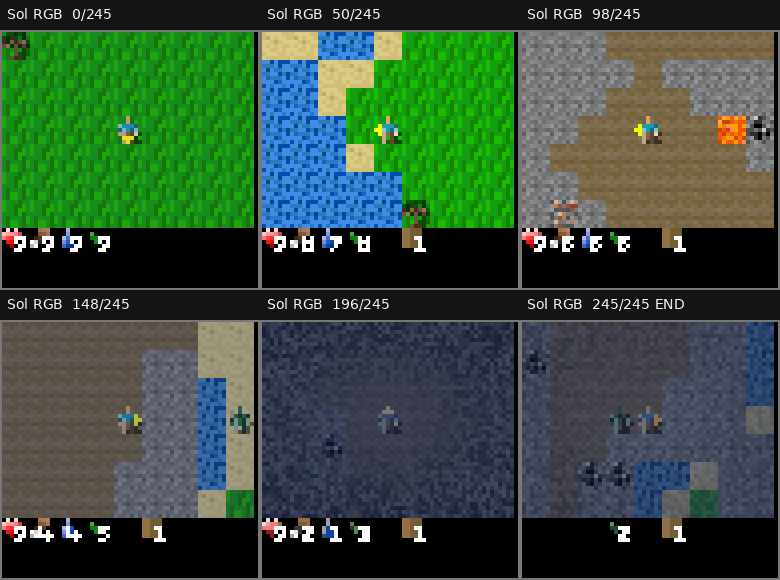 | RGB · 162 steps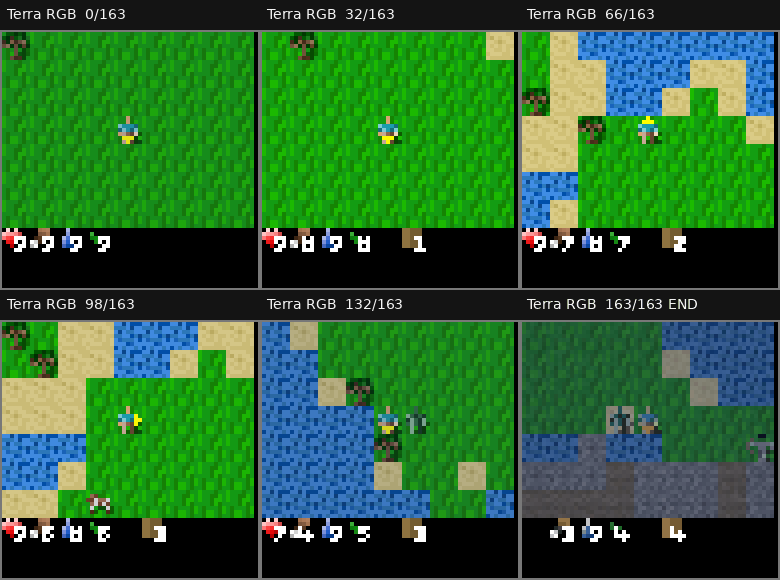 | RGB · 162 steps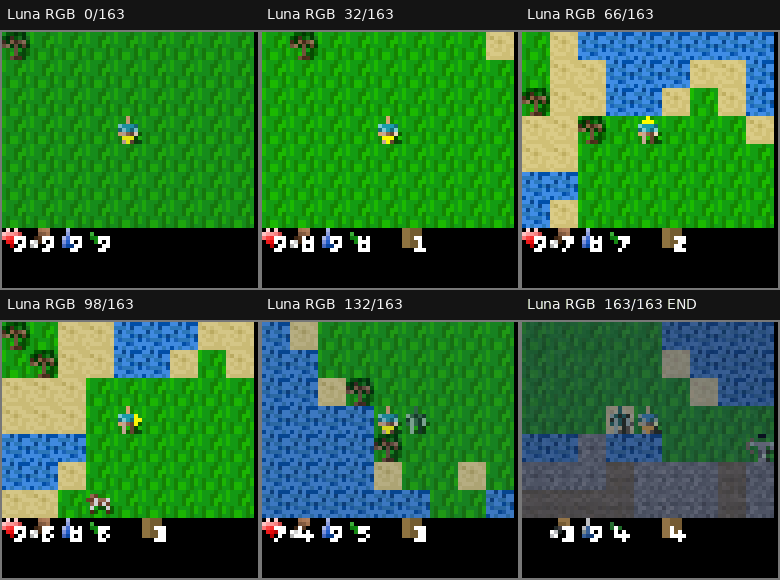 |
Symbolic · 391 steps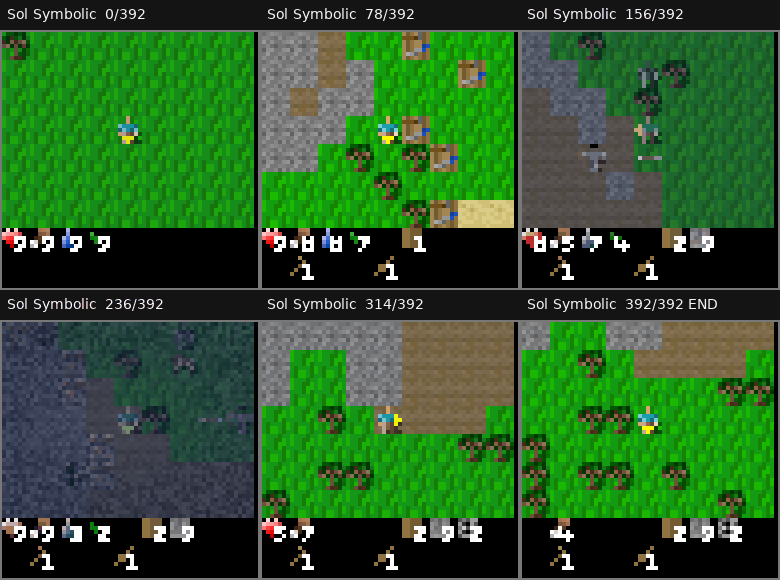 | Symbolic · 261 steps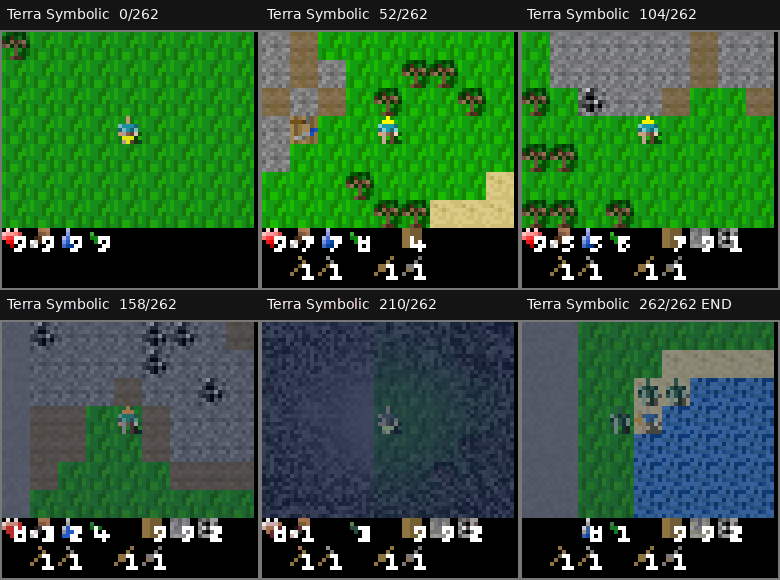 | Symbolic · 194 steps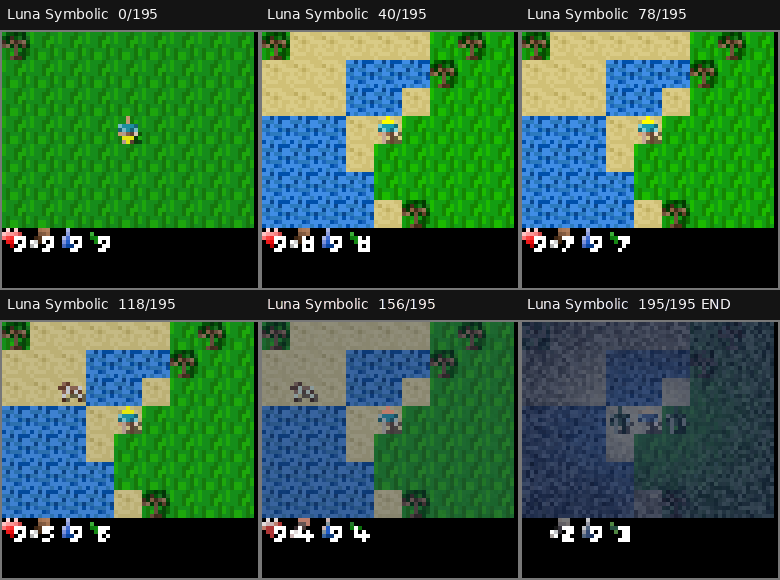 |
The symbolic row now reflects the aggregate ordering clearly: Sol continues longest, Terra occupies the middle, and Luna ends much earlier. Terra RGB and Luna RGB cannot be separated on a common Episode because both Runs selected the byte-identical packaged baseline; their matching replays and 162-step outcomes are intentional.
Three Agents, Different Bottlenecks
The paired results expose a different limiting factor for each Agent.
Sol: strong RGB progress, then another large gain
Sol already beats the packaged baseline with RGB, then improves again with symbolic input: LHS rises from 5.70 to 11.53, mean survival from 195 to 316 steps, and coverage from 10/22 to 18/22. It can jointly improve perception and control, but more reliable state recognition still unlocks a large gain.
Terra: perception was a major bottleneck
Terra's RGB Run falls back to the unmodified baseline, while symbolic input raises LHS from 4.58 to 9.88, mean survival from 164 to 291 steps, and coverage from 5/22 to 14/22. Visual state extraction was therefore its dominant bottleneck in this Run.
Luna: better recognition does not solve coordination
Luna also falls back to the baseline under RGB. Symbolic input expands coverage from 5/22 to 11/22, but LHS only moves from 4.58 to 4.97 and mean survival from 164 to 178 steps. Its remaining bottleneck is long-horizon coordination rather than recognition alone.
Changing the observation contract affects their policy evolution in fundamentally different ways.
What Does the Ablation Tell Us?
At first glance, Crafter poses a single challenge: evolve a Policy that can survive and develop in an open world.
The paired experiment shows that the difficulty can originate at different stages.
For Sol and Terra, local visual state extraction is a major part of the challenge. Removing object recognition, HUD reading, and nighttime visual ambiguity leads to much stronger survival and technology progression.
For Luna, perception is only part of the problem. Cleaner state information enables broader development, but the resulting Policy still struggles to turn those capabilities into reliable long-horizon survival.
This is the distinction we want environments such as Crafter to expose.
A final scalar score tells us which Program performs better. Controlled changes to the observation interface can additionally reveal where policy evolution stops improving.
Crafter therefore evaluates more than whether a coding Agent can write a game-playing Policy. It gives us a way to separate failures of perception from failures of long-horizon planning, control, and program coordination.
These six Runs represent individual policy-evolution trajectories rather than repeated statistical trials, and their training Episode consumption is not identical. We therefore do not interpret them as a general ranking of Sol, Terra, and Luna.
The narrower observation is more informative:
Removing local visual recognition transforms the Policies evolved by Sol and Terra, but only modestly improves Luna's survival—revealing different bottlenecks behind long-horizon policy evolution.